FICTION · DRAMA · CREATIVE INTELLIGENCE
In brief
Three lines for today
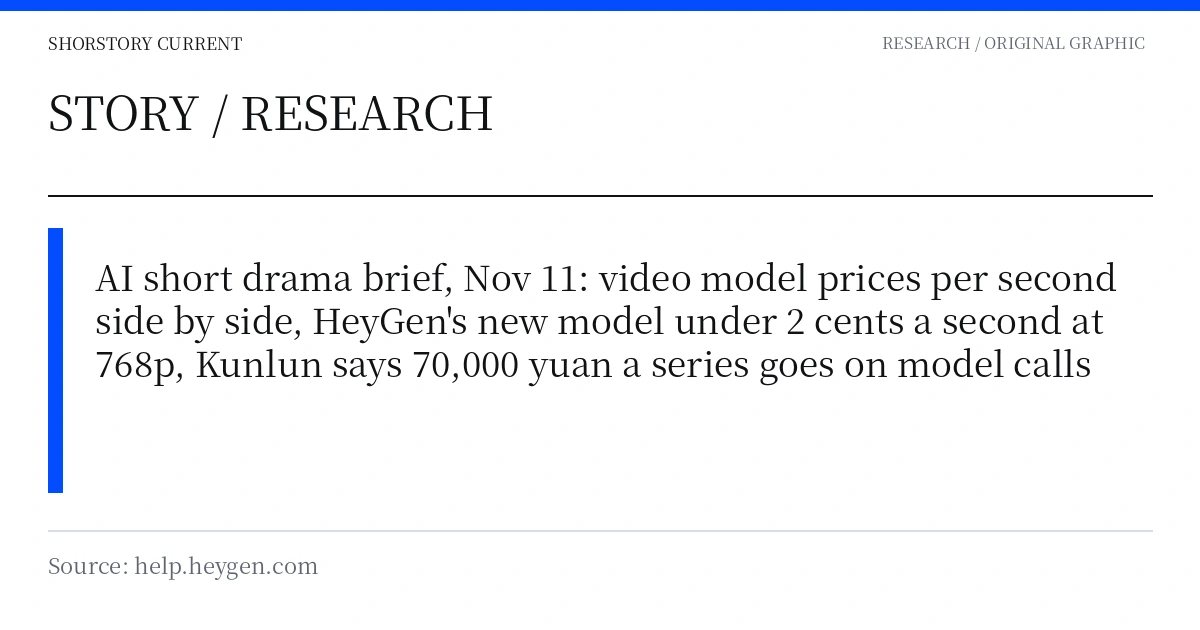
1. Price: HeyGen launched its first general-purpose video model at $0.018 a second for 768p on its own API during a launch promotion ($0.03 from December 1), under a third of what MiniMax H3 Max ($0.08 at 768p) or Google's Omni 1.2 Flash ($0.07 at 720p) charge; our Wednesday price table is below.
2. Cost structure: Kunlun Tech CEO Fang Han says a roughly 200,000-yuan AI short drama still spends 70,000 to 80,000 yuan on model calls, that about one series in 200 becomes a hit, and that even the best video model's clips have no better than a 20% chance of being cut into a good show.
3. Business models: India's Dashverse shut its consumer microdrama app to sell AI production software, and Eloelo, fresh from an $80 million round, is also investing in its own production suite; in North America, ads and hard-to-cancel subscriptions account for about three in ten complaints about the leading app.
Models and pricing (Wednesday price table)
Official change today: a HeyGen help page updated on November 9 announces HeyGen Video, its first general-purpose video model, with text-to-video, image-to-video and reference-video modes and dialogue, ambience and sound effects generated in the same call. It bills per output second at half price through November 30. Official rates (promotion / from December 1): 480p $0.01 / $0.02 a second, 768p $0.018 / $0.03, 1080p $0.04 and 2K $0.05 (no regular rate listed). Clips over 15 seconds bill at $0.045 for 480p, $0.075 for 768p and $0.105 for 1080p and above, about four times the under-15-second rate, and reference-video mode bills input seconds too. HeyGen says it ranked first for quality in a 4,800-vote blind test against Seedance 2.5 and Kling 3.0, among others; that is the company's own claim. No change at the other sources we checked: Google's Omni 1.2 Flash blog post (November 5, $0.07 a second at 720p) and Runway's developer price list.
Per-second prices in US dollars. HeyGen's are its own direct rates and Google publishes its own 720p Omni rate; all others are reseller prices from Runway's developer price list, read November 11, excluding reference-video surcharges:
· HeyGen Video: 480p 0.01 | 768p 0.018 | 1080p 0.04 (promotion through 11/30)
· MiniMax H3 Max: 480p 0.05 | 768p 0.08 (5-second minimum)
· Wan 3.0: 480p 0.05 | 720p 0.10 | 1080p 0.20; Wan 3.0 Prime 0.068 | 0.14 | 0.28
· Gemini Omni 1.2 Flash: 360p 0.02 | 720p 0.07 | 1080p 0.10 | 4K 0.21
· Kling 4.0 Flash: 720p 0.094; Kling 4.0: 720p 0.157 | 1080p 0.235 (20% off to 0.1256 | 0.188 through 11/30); Kling 3.0 Pro: 0.12, or 0.17 with audio
· Seedance 2.0 Mini: 480p 0.07 | 720p 0.15; 2.0 Fast: 0.11 | 0.24; 2.0: 0.14 | 0.30 | 1080p 0.40
· Seedance 2.5: 480p 0.20 | 720p 0.30 | 1080p 0.68 ($0.80 minimum per generation)
· Veo 3.1: 0.40 with audio, 0.20 without; Veo 3.1 Fast: 0.15 | 0.10 (same rate at 720p and 1080p)
Rough generation cost of one minute at the 720p tier, before retakes: HeyGen about $1.10 ($1.80 at the regular rate), Omni $4.20, H3 Max $4.80, Kling Flash $5.60, Wan 3.0 $6.00, discounted Kling 4.0 $7.50, Seedance 2.5 $18 and Veo 3.1 with audio $24. Limits: reseller, direct and negotiated enterprise prices are three different things, and we have not tested quality or retake rates.
Platforms and channels
Indian microdrama companies are turning their production tools into the product. The Economic Times reported on November 10 that Peak XV-backed Dashverse has shut its consumer platform DashReels and is seeking $30 million to $40 million, mostly for Frameo AI, its video-production software for businesses, and that Eloelo, which recently closed an $80 million Series C led by Hornbill Capital and NBCUniversal, is investing in its own production suite, Dolphin AI. The paper cites rising subscriber acquisition costs, churn and scrutiny of recurring payments. The full article is paywalled; we read only the summary and opening.
Subscription friction is showing. Chinese outlet Dramagoing, citing App Vulture data to November 3, reported on November 10 that ReelShort's app rating stands at 3.8 across about 1.97 million ratings, with 42.5% giving one star; "too many ads" accounts for 17% of negative reviews and subscription cancellation and billing problems for 14%. This is secondhand, and store ratings are not a retention measure.
Charts and hooks
For this week's overseas chart, see our November 10 brief (GASP, November 1–8). One note on genre today: Fang Han says overseas viewers respond more to underdog comebacks than to domineering-CEO stories, and that vampire stories his team expected to work did worse than werewolf ones; over 95% of new series on his platforms in September were AI-generated. These are company statements.
Adaptation and IP
Remaking an existing hit as a multilingual AI series is a route someone has already run. Xinhua reported on November 10 that a Changsha company remade a popular Chinese short drama in AI and released English, Spanish and Portuguese versions at once; it peaked at fifth on an overseas AI-drama daily chart and brought in close to 1 million yuan in two months. The company has released more than ten AI series across Europe, the Americas, the Middle East and Southeast Asia, and earns 60% of its revenue abroad. The chart is not named, and the figures are the company's.
Methods and workflow
Kunlun Tech splits short-drama production into seven steps: topic research, scripting, video generation, music and sound, multilingual localization, global distribution, and feeding post-release data back in, and says it now links them with one coordinated agent system (a November 5 talk in Hangzhou, published by the company on November 10). Fang Han argues that point tools break down at the handoffs between steps, and that three things still need people: the script, taste (the same model gives different results depending on who keeps regenerating and choosing), and localization.
Localization is getting faster: the same Xinhua report says the Malanshan audio-video lab's AI dubbing platform has cut translation of 120 minutes of subtitles from at least three days to four or five hours, and had handled translation and dubbing for 16,000 series-jobs in more than 40 languages by October. Reproducibility: organizations' own statements, untested.
What it means today
1. If you make samplers or previz: add HeyGen Video at 768p and Omni 1.2 Flash to the same prompt comparison while the promotion lasts to November 30, and keep shots under 15 seconds, since longer clips cost about four times as much per second.
2. If you budget a series: on Fang Han's figures, model calls are about 35% to 40% of a series' cost, so budget on per-second price times your retake multiple times finished seconds, not on list prices alone.
3. If you distribute abroad: release a proven series in English, Spanish and Portuguese together; if you run your own subscriptions, make cancellation and billing terms easy to find, since ads and billing drive about three in ten complaints.
What remains unclear
HeyGen's blind-test ranking and the Kunlun and Changsha figures are company statements; the Economic Times article is paywalled and we used only its summary; the App Vulture data is secondhand via Dramagoing. Prices are list or reseller rates without enterprise discounts. We tested no model's quality or retake rate and contacted none of the companies.
Method & limitations
On November 11, 2026 (Beijing time) we read HeyGen's official help page (updated November 9), Google's Omni 1.2 Flash blog post (November 5), Runway's developer price list, the Economic Times (November 10), Kunlun Tech's November 10 release of Fang Han's talk (as reposted by 10jqka), Xinhua (November 10) and Dramagoing's November 10 brief. The main window is November 9–10; the price table shows rates on the day read. Vendor prices, reseller prices, press accounts and editorial inference are labeled separately.
Prices are list, promotional or reseller rates without enterprise discounts, with no quality or retake testing; HeyGen's ranking and the companies' business figures are self-reported; the Economic Times article is paywalled; the App Vulture data is secondhand; we contacted no party; nothing here supports conclusions about any company's revenue or ranking.
Related research & methods
Vertical Drama Cliffhanger Types: 6 Episode Endings, Where to Cut, and a 12-Episode Rotation
Sources & editorial note
These links identify the public sources. Third-party statistics remain attributed to their publisher; our studies state what was actually read or viewed. See the methodology for scope and limits.
Source published: Nov 9, 2026
Source published: Unknown; not confirmed by the source
Source published: Nov 5, 2026
Source published: Nov 10, 2026
Source published: Nov 10, 2026
Source published: Nov 10, 2026
Source published: Nov 10, 2026
- Published
- Nov 11, 2026
- Updated
- 11 Nov 2026, 07:56
- Verified
- 11 Nov 2026, 07:54