FICTION · DRAMA · CREATIVE INTELLIGENCE
In brief
Find what actually changes between candidates
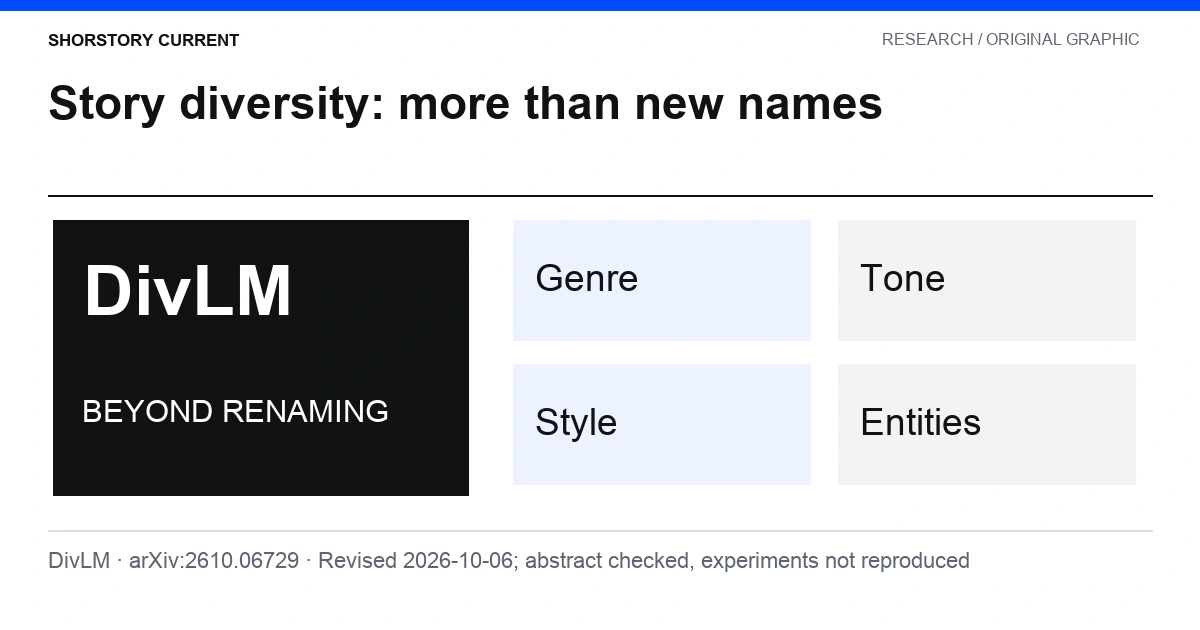
Several pitches with different character names may still offer an editor essentially the same choice. DivLM considers dimensions including genre, tone, style and entities. Those distinctions can inform a comparison of pitches, although the paper has not validated the editorial process proposed here.
Submitted October 5 and revised October 6, the paper combines creative-corpus training with reinforcement learning to target diversity and quality. Its abstract reports improvements in two model families. We checked the abstract and version dates, without reviewing the full text or code or reproducing the experiments.
Compare decisions, not just labels
For each existing candidate, write one sentence describing the central conflict, then note changes in genre, tone, narrative style, characters and setting. If only names and locations differ, examine whether the protagonist makes a different choice or faces a different consequence. This is our editorial recommendation, not a reported experimental finding.
Once a candidate is worth developing, assess whether its conflict suits a short story or a longer work. The abstract’s short-story results do not answer questions about serial consistency, commercial performance or training costs, and alone do not justify a model-training investment.
Method & limitations
Discovered through an existing weekly digest; checked arXiv abstract and version dates.
Full text and code were not reviewed. Short-story results do not establish commercial gains.
Sources & editorial note
These links identify the public sources. Third-party statistics remain attributed to their publisher; our studies state what was actually read or viewed. See the methodology for scope and limits.
Source published: Oct 5, 2026
- Published
- Oct 13, 2026
- Updated
- 15 Oct 2026, 10:47
- Verified
- 13 Oct 2026, 14:07