FICTION · DRAMA · CREATIVE INTELLIGENCE
In brief
Four premises make the cost of a choice visible
Saving or not saving; buying a car earlier or later; one or two weekly rest days; immediate factory earnings or time spent learning a skill. Four five-figure-like premises from 人生副本 turn an alternative life into choices about money, time and skills. For a scriptwriter, the sacrifice on each side is more concrete than the phrase “a different life.”
In the October 12 cumulative snapshot, the saving post, published September 8, has about 22,000 likes; the September 14 car post about 13,000; the September 17 rest-day post about 22,000; and the October 3 skills post about 12,000. These are publication dates, not dates of crossing 10,000 likes. Large displayed counts are rounded.
These readings come from visible titles and descriptions. The works were not fully viewed, so a premise cannot establish how the setup, editing or ending actually works.
Put the four-day working week beside them
An October 1 premise contrasting four and six working days has only 111 likes in the snapshot, despite its similarity to the higher-like rest-day premise. A September 16 post about subsidizing a younger brother versus helping when needed has 100; an October 5 weekend side-job comparison has 149. Practical trade-offs can produce very different counts.
This does not establish inferior scripts. Covers, openings, recommendations and publication times may affect the result. It does show why a two-lives format and a practical choice are insufficient as a repeatable performance formula.
The full 47-post distribution puts the peaks in context
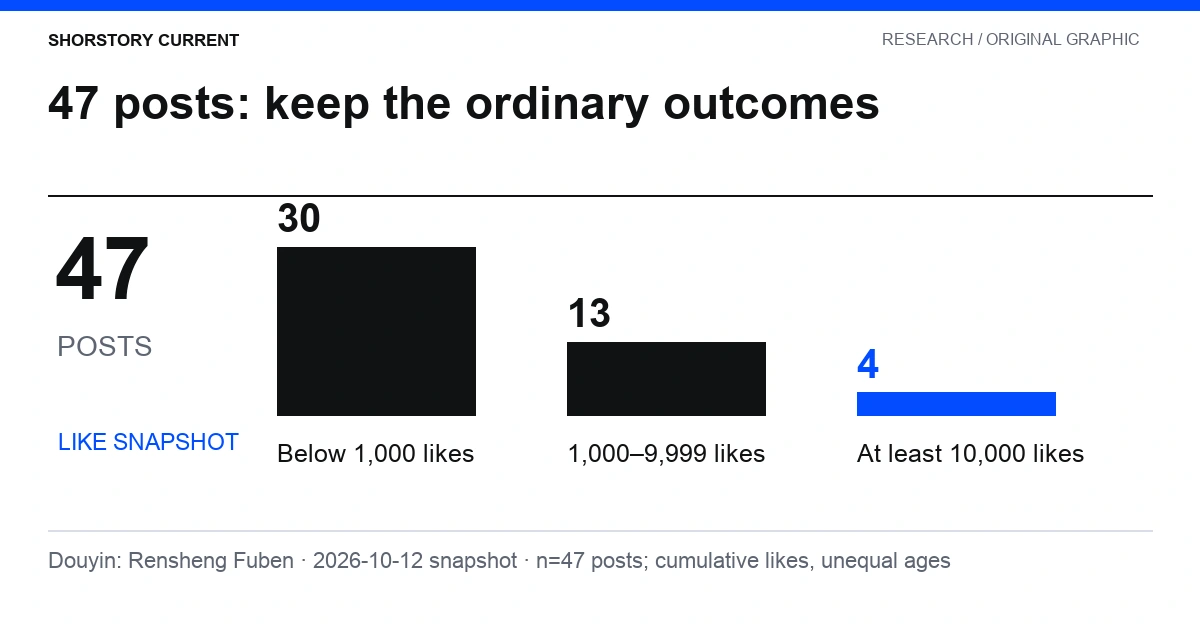
Of 47 visible posts, 30 have fewer than 1,000 likes, 13 have 1,000–9,999, and four have at least 10,000. The median is 183. Forty-five readable publication dates span August 19–October 12; two are unknown. The posts have had different amounts of time to accumulate exposure.
By publication month, the snapshot median is 124 for 14 August posts, 425 for 25 September posts and 178 for six October posts through the 12th. These are cumulative readings from one October 12 cross-section, not proof of continued improvement or declining creative ability.
Give each path a credible benefit
Our writing hypothesis is to make both options worth considering before showing their costs. Rest days trade income against time off; skills trade immediate earnings against time to learn. If one path is always correct and the other offers only punishment, the audience can recognize the author’s answer early.
In an original script, mark each path’s first gain, first loss and the action that follows. This remains a method to test. Titles and likes neither reveal how these works deliver that sequence nor establish that the method improves performance.
Complete one decision before expanding the timespan
Start with what the character gains now, what it costs later and what they do in response. Add years and locations only when that change requires them. Let the chain of consequences determine the scenes and runtime.
For deeper viewing, compare the higher-like rest-day post and lower-like working-week post using the same record of setup and payoff. Their full execution has not yet been observed, so leave the answers open. Future comparisons of your own work should also use matching post-publication windows.
Keep the hypothesis and its counterexample
This material can select a pair worth viewing and help examine whether an original script merely announces the correct choice. It contains no revenue, completion, advertising or equal-age exposure data with which to forecast earnings or a reliable hit rate.
The higher-like premises suggest that practical trade-offs may make a story easy to understand. Similar lower-like premises require further explanation. Keeping both gives later viewing a chance to overturn the initial interpretation.
2026-10-12 – 2026-10-12 · Sample denominator: 47 · posts
Bar scale: 0–47 posts
| Item | posts |
|---|---|
| Below 1,000 | 30 |
| 1,000–9,999 | 13 |
| At least 10,000 | 4 |
October 12 snapshot; exclusive bins sum to 47.
Not daily new likes; two publication dates are unknown and exposure ages differ.
Data source 1Method & limitations
Reuses 47 existing public-post records and checks mutually exclusive like-count bins. Likes are frozen as of October 12, 2026; dates were supplemented October 13. The 45 known dates span August 19–October 12. Premise summaries derive from visible titles and descriptions, without inventing unseen plot details.
One account’s visible sample, not its full history or the whole category. Exposure ages differ, large counts are rounded and two dates are missing. Full viewing, equal-age performance and earnings are unavailable. No contact information or new account visits are included.
Sources & editorial note
These links identify the public sources. Third-party statistics remain attributed to their publisher; our studies state what was actually read or viewed. See the methodology for scope and limits.
Source published: Unknown; not confirmed by the source
Source published: Sep 8, 2026
Source published: Sep 14, 2026
Source published: Sep 16, 2026
Source published: Sep 17, 2026
Source published: Oct 1, 2026
Source published: Oct 3, 2026
Source published: Oct 5, 2026
- Published
- Oct 13, 2026
- Updated
- 15 Oct 2026, 10:53
- Verified
- 13 Oct 2026, 15:26