FICTION · DRAMA · CREATIVE INTELLIGENCE
In brief
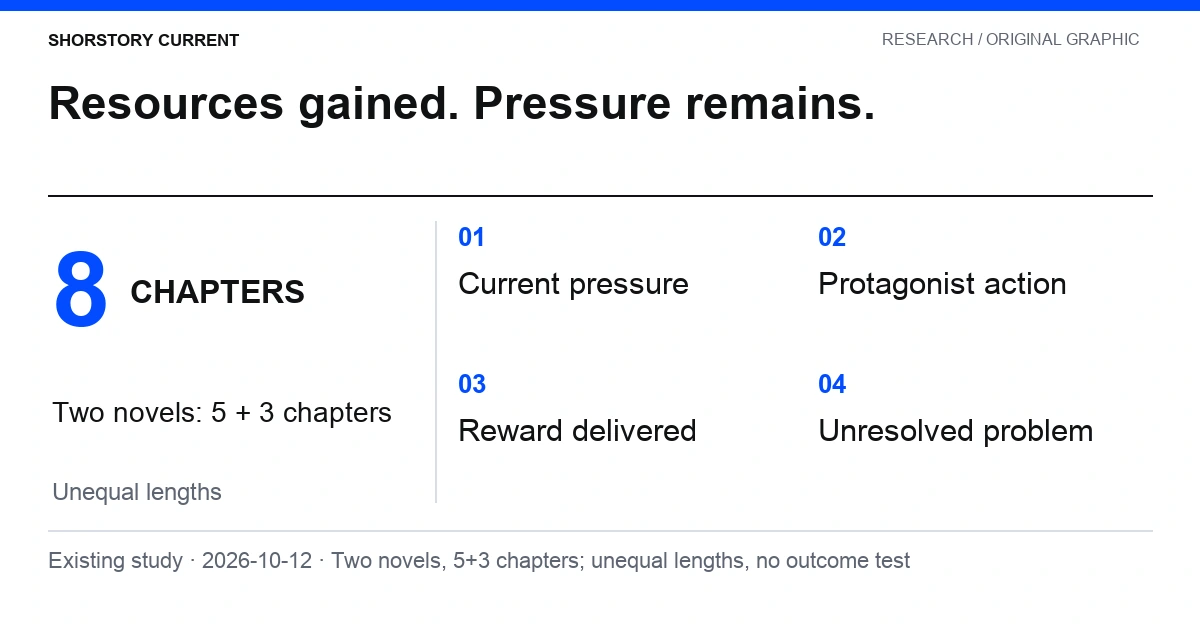
Eight chapters: how conflict continues
An opening can repeatedly reward its protagonist and still sustain suspense. It can also give her repeated moments of resistance without ending her predicament. The distinction is whether each gain changes what she can do. This archive compares chapters 1–5 of Billionaire’s Match with chapters 1–3 of Meet My Brothers through resources, choices and continuing pressure.
The first sample contained approximately 9,593 words and the second 2,441 under the original study’s English-word counting rule. These are unequal reading spans, not a controlled comparison of payoff frequency. The study was completed on October 12, 2026 and included cached public-page returns; current free access is not reasserted here.
After a gain, leave a concrete problem for the next scene
In Billionaire’s Match, an inheritance promise is established in chapter 1 and gains social recognition in chapter 3. Chapter 4 then turns the reward into pressure to defend it. Eligibility, recognition and the ability to exercise a right safely are three different story beats. Collapsing them into a single victory can leave subsequent conflict repeating the same humiliation.
Leaving an exploitative relationship also unfolds in stages: a limited benefit is recovered in chapter 2, accommodation is secured in chapter 3, and withdrawal becomes action in chapter 5. Earlier work remains controlled by others and the reliability of a new alliance remains unresolved. The transferable structure is a reward changing one condition while exposing another problem, rather than an inheritance plot.
For an outline review, describe each gain with an observable verb: obtain, prove, refuse, leave or recover. Add what it still cannot solve. If the next scene merely debates a fact already established, check whether the conflict has actually escalated.
What the protagonist changes—and what help changes
In chapter 3 of the main sample, the protagonist insists on verification while outside intervention prevents forced removal. In chapter 4, the refusal to sign is hers, while immediate escape from coercion depends on assistance. Recording these separately recognizes agency without mistaking rescue for a capability upgrade. In chapter 5 she chooses an alliance and withdraws earlier support, while protection still depends partly on others.
Outside help is not a defect that every writer must remove. It can establish a relationship promise or introduce an exchange. The useful questions are whether the protagonist made a consequential choice before help arrived, and what she can change after it leaves. If every improvement is delivered by someone stronger, desire can become detached from action.
A counterexample: resistance can coexist with rising pressure
The first three chapters of Meet My Brothers follow a different trajectory: a relationship ending and the wish to protect a child establish pressure, while dependence on material resources pushes back against local resistance. A secret known to the reader, someone worth protecting and the opponent’s leverage keep the next action unresolved. The absence of an equally large material reward does not establish inferior pacing.
A rebuttal, a recovered benefit, public recognition and temporary safety offer different satisfactions. Combining them into a required payoff every fixed number of words conceals the emotional trajectory. Editors can ask whether an earlier promise has been honored without using eight chapters to prescribe a universal romance or short-drama quota.
Length and dialogue: measurements do not replace reading
The main sample uses close explanation of emotion and intention, brief shifts into an opponent’s thoughts and dialogue for negotiation. Class and asset information is embedded in conflict. The shorter comparison opening concentrates on exclusion and dependence. A vertical-screen adaptation review can ask which explanations must become visible choices and which relationship information belongs in dialogue. This is an editorial proposal, not a tested shot plan.
The study measured extracted lines and quoted words, neither of which equals original webpage paragraphs or exclusively spoken dialogue. Correcting repeated opening quotation marks changed the chapter 4 quotation proxy from 48.58% to 36.63%. Verify text formatting before treating a percentage as a stylistic rule; a regular expression should not decide a dialogue quota.
Turn the archive into a bounded outline review
Choose an opening you have already drafted rather than rewriting a whole book. For each scene, record the current pressure, the protagonist’s action, the delivered change and the unresolved problem. Keep assistance in a separate column. At the chapter ending, ask whether the next scene has a concrete action objective. If it offers only another demonstration of strength or another surprised crowd, clarify the opponent’s response and the remaining constraint.
These questions suit identity reversals, resource struggles and exits from relationships. Slow-burn relationships, ensemble stories and intentional pauses require judgment against their own promises rather than forced retaliation. Compare causal clarity before and after revision, then use real readers to assess the emotional effect. This article provides no retention, paid-conversion or revenue evidence.
Method & limitations
Reused the eight-chapter records and pressure ledger with matching evidence hashes. Official public-page returns included cached versions. Original publication dates are unknown; this article’s preparation date is not a source date.
Two books and eight chapters do not represent a genre. Current regional or account access was not verified. Extracted lines and quotation counts are proxies, so no exact dialogue share is claimed. Retention, paid conversion and method effectiveness were not tested.
Related research & methods
Lycan Queen’s first three episodes: making hidden identity visible through conflict
More wolf titles weekly, more wealth titles cumulatively: turning charts into story questions
Sources & editorial note
These links identify the public sources. Third-party statistics remain attributed to their publisher; our studies state what was actually read or viewed. See the methodology for scope and limits.
Source published: Unknown; not confirmed by the source
Source published: Unknown; not confirmed by the source
- Published
- Oct 13, 2026
- Updated
- 13 Oct 2026, 15:26
- Verified
- 13 Oct 2026, 15:26