FICTION · DRAMA · CREATIVE INTELLIGENCE
In brief
Who this is for, and what it helps you decide
Micro-drama producers registered in Guangdong, platforms headquartered there, and teams or individual creators who upload micro-dramas through accounts on those platforms. It helps you decide whether to send comments before November 11, whether to plan production and review schedules around Class II filing and a 15-working-day review, and whether account uploads will need a licence or programme number in advance.
This is a draft for comment, not a rule in force. The final version may change, so it is too early to make irreversible decisions on it.
What the draft adds to the national rules
Scope: Article 2 says the rules apply to organisations in Guangdong engaged in creating, shooting, distributing, broadcasting, marketing or licensing micro-dramas.
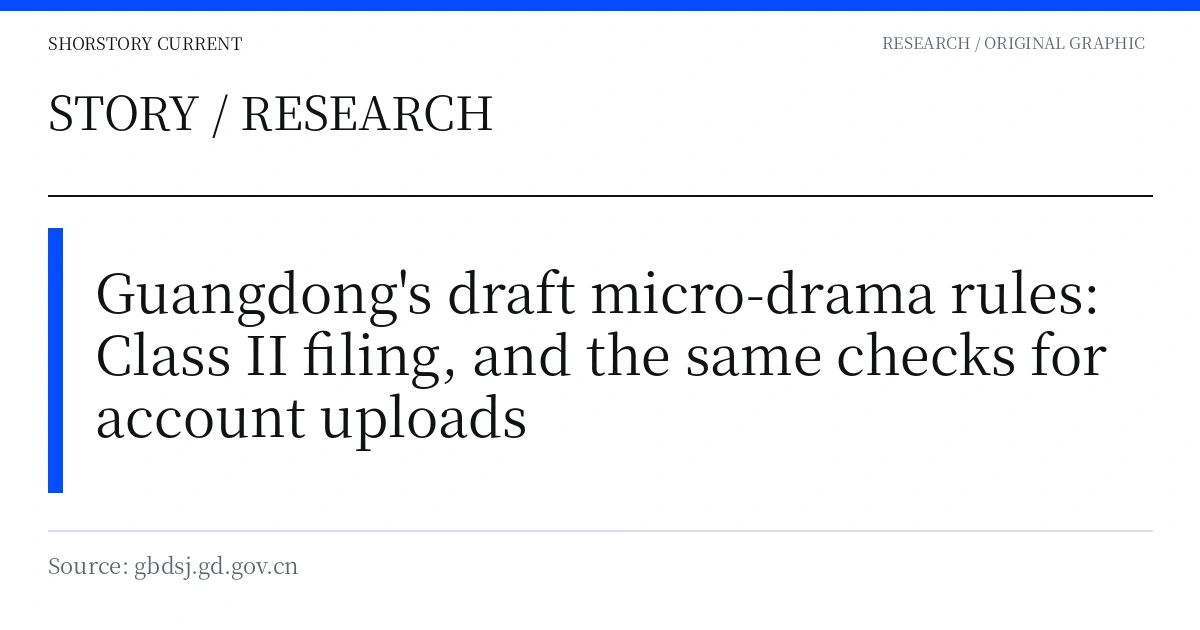
Class II filing: Article 12 of the national Micro-Drama Development Management Measures (NRTA Order No. 16, in force since September 1, 2026) requires filing and public notice for Class I dramas and says Class II dramas "may" follow the same process. Article 10 of Guangdong's draft applies filing to both Class I and Class II, and says organisations in the province "shall" apply to the provincial bureau before shooting.
Review clock: Article 19 of the draft says the provincial bureau decides on Class I and II review applications within 15 working days of acceptance, including 10 working days of expert review; Article 18 says missing materials will be flagged once, within 2 working days. Article 20 of the national rules gives "20 days" for Class I without saying whether these are working days, so the two periods cannot be compared directly.
Changes and overseas releases: under Article 14 of the draft, changing a listed drama's main character roles or overall story direction requires a new filing, while changes to title, episode count or running time need a change procedure. Article 53 requires Guangdong organisations making micro-dramas for broadcast abroad to also report title information, a synopsis and broadcast plans to their city-level bureau.
Platforms and account uploads: the added duties
Article 33 of the national rules covers "non-professionally made, short online audiovisual content with micro-drama characteristics", asking platforms to manage that content and maintain monitoring and emergency handling.
Article 34 of Guangdong's draft extends this to "micro-dramas uploaded by organisational or individual users through accounts", and says they must be handled the same way as other dramas: checking the licence or approval document for Class I and II, and pre-broadcast review plus a programme number for Class III. The same article bars platforms from carrying self-made special-subject dramas uploaded by individuals, or dramas made with foreign personnel without approval, and from giving either a programme number.
The direct implication for account creators: a micro-drama uploaded to a Guangdong platform may need platform review and a programme number before it can go live. For filing and review, the draft says detailed procedures will be "published by the provincial bureau to producers"; we found no published procedure, and the draft gives no further detail on how account uploads will be reviewed.
AI labels, and the reported "interactive drama" rule
Article 35 of the draft matches Article 34 of the national rules: micro-dramas generated or made with artificial intelligence must carry a notice in a prominent place in every episode. Article 6 also encourages the use of AI, virtual production, ultra-high definition and interactive storytelling in production.
Dianyingjie reported on October 16 that the rules use "how the core content is made" to decide whether an interactive micro-drama follows live-action or AI classification standards. We read the full draft attached to the Guangdong bureau's notice and did not find such a provision; the word "interactive" appears only in Article 6's list of encouraged technologies. The claim may come from another document or may be a misreading. Until an official source is identified, rely on the attachment to the notice.
How to comment
The notice lists two routes: email gdwlstjmglc@126.com, or post a letter to Room 2115, Phase II, Radio and Television Centre, 331 Huanshi East Road, Yuexiu District, Guangzhou (postcode 510066), marking the envelope as comments on the Guangdong implementing rules for the Micro-Drama Development Management Measures. The deadline is November 11, 2026.
Article 54 of the draft says the rules take effect on publication and are valid for five years.
What it may mean for creators (editorial inference, not tested by us)
If the final text keeps mandatory filing for Class II, Guangdong producers of Class II dramas may face an extra filing step before shooting, so schedules should leave room for it.
For teams used to uploading short dramas straight from an account, a programme number may become a required step before release. Until the procedures are published, it is worth having title information, a synopsis and the main cast and crew list ready.
These are readings of a draft text, not of final rules, and they are not legal advice.
Method & limitations
We read the Guangdong Provincial Radio and Television Bureau's October 12 notice and the full draft attached to it (a .doc file, converted to plain text and read article by article), the full text of NRTA Order No. 16, the Micro-Drama Development Management Measures, on the NRTA website, and Dianyingjie's October 16 report. We compared only the provisions cited here. Official text, media claims and editorial inference are labelled separately. The October 12 event date is the notice date; we read these pages on October 19, 2026 (Beijing time).
This is a draft for comment, and the final version may change. We are not legal professionals, and this is not legal advice. We compared only the provisions mentioned, not every article of both documents. Converting the .doc attachment to plain text may have lost formatting. The standards that define Class I, II and III dramas are set by the NRTA and are not part of this draft. The procedures for filing, review and programme numbers have not been published. We could not identify the source of the reported interactive-drama provision. English renderings of Chinese legal terms are our own.
Sources & editorial note
These links identify the public sources. Third-party statistics remain attributed to their publisher; our studies state what was actually read or viewed. See the methodology for scope and limits.
Source published: Oct 12, 2026
Source published: Oct 12, 2026
Source published: Jul 31, 2026
Source published: Oct 16, 2026
- Published
- Oct 19, 2026
- Updated
- 19 Oct 2026, 08:04
- Verified
- 19 Oct 2026, 08:04