FICTION · DRAMA · CREATIVE INTELLIGENCE
In brief
Who this is for, and what it helps you decide
Creators and small teams making AI short dramas, motion-comic storyboards or ad test clips who are weighing self-hosted or local generation against cloud APIs—especially anyone already using reference images or clips for character consistency and wanting matching speech or soundtrack in the same pass.
It helps you decide whether to try the open-weight FastH3-Omni path now, whether the license covers your location and commercial scale, whether to start from ComfyUI or a UniServe/server recipe, and how to treat Nuva’s separate production offering versus the public weights. We did not bench quality, and we do not endorse revenue or ranking claims.
What shipped
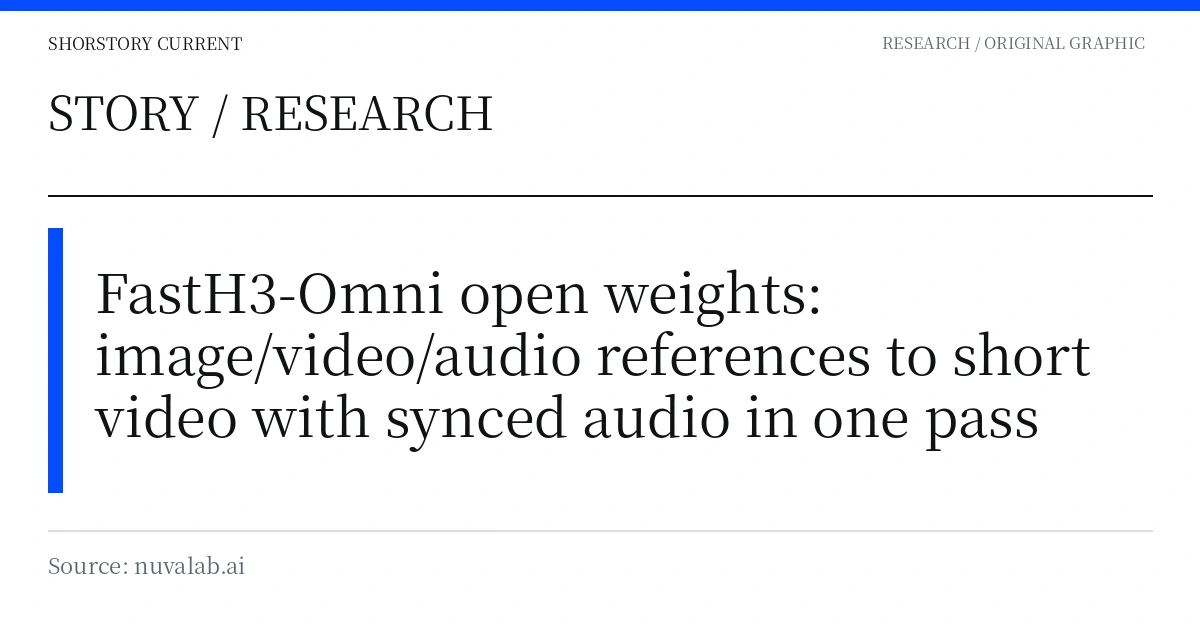
According to Nuva Lab’s release page (labelled Release · October 20, 2026) and FastVideo’s same-day post, FastH3-Omni is a few-step, sparse-distilled MiniMax H3 for reference-conditioned video-and-audio generation (Ref2VA / omni reference). It takes a text prompt plus ordered image, video and audio references and returns video with a synchronized soundtrack in one pass, without a separate dubbing step.
Nuva’s copy says the model matches MiniMax H3’s full omni reference mode and the same mix of image, video and audio inputs as Seedance 2.5, and generates about 5–15 seconds at 24 fps. The Hugging Face card for FastVideo-FastH3-Omni-8-Step-V1 adds: up to nine images, three videos and three audio clips, at most twelve references in total, with at least one image or video required; output is video with 32 kHz stereo audio at 24 FPS; sampling uses eight transformer evaluations (versus the 50 steps they attribute to the Base path).
The speed claim is the publishers’: 5.6–11.9× lower end-to-end latency than default MiniMax H3 omni reference across 27 matched workloads on eight NVIDIA GB200 GPUs, measured by FastVideo on full serving recipes against Base’s lossless numerical policy (see their methodology). We did not reproduce that benchmark.
Weights, code and ComfyUI
Open weights sit at Hugging Face under FastVideo/FastVideo-FastH3-Omni-8-Step-V1. Nuva also points to FastVideo’s GitHub for code and training, and to UniServe deployment guides. The model card says the BF16 checkpoint expects MiniMax-H3’s shared text encoder, tokenizer and video/audio VAEs; local paths include NVFP4 QAD variants and device recipes for hardware such as DGX Spark and RTX 5090.
FastVideo/FastH3-Omni-Comfy publishes ComfyUI-ready BF16 and INT8 ConvRot diffusion files and tells you to install matching text encoders and video/audio VAEs. The public Hugging Face model API reports createdAt 2026-10-20T04:58:26Z and lastModified 2026-10-20T21:58:57Z (UTC) for that Comfy repo, inside the October 20 release window. The page’s relative “Updated N days ago” label is not a reliable event date.
Nuva separately sells a hosted production build with more data and optimizations. The publishers themselves distinguish it from the open release; we did not compare the two.
License: open weight is not OSI open source
The HF cards mark the license as minimax-h3-community-license-agreement and link to MiniMaxAI/MiniMax-H3’s LICENSE. We read that agreement in full (dated August 2, 2026 at the top).
In our reading of the text: the grant is limited to an “Applicable Territory” that excludes the European Union, the United Kingdom, the Republic of Korea and the United States of America; use, distribution or display outside that territory is not authorized by this agreement, and parties in excluded territories are directed to contact MiniMax for a separate license. Commercial products and services with more than USD 20 million yearly revenue need prior written authorization, and commercial UIs must prominently display “MiniMax H3”. An Acceptable Use Policy and further bans also apply.
So even when release pages say “open source” or “open weight,” the decision that matters for creators is the community license’s territorial and commercial terms, not the OSI definition. Teams in excluded territories, or past the revenue threshold, should not treat a downloadable checkpoint as a commercial green light.
What it may mean for creators (editorial inference, not tested by us)
If your pipeline needs the same character across shots plus a reference voice or track, an open omni-reference model that emits video and audio together could cut a dubbing/sync step—only if you can run it lawfully in your territory and absorb local VRAM and engineering cost.
Short-drama teams already on ComfyUI can check whether FastH3-Omni-Comfy’s file layout drops into their graphs; teams chasing throughput are pointed at UniServe and multi-GPU recipes instead.
Versus closed cloud video APIs, open weights buy controllable deploy and fine-tune room, not a worldwide commercial free-for-all. Before choosing a stack, check whether your location is excluded, whether revenue triggers extra authorization, and whether you must pass license restrictions to downstream users.
These implications are editorial inference. We have not run the model on any GPU, and we have not verified the latency multiples or quality versus MiniMax H3 or Seedance.
Method & limitations
On October 23, 2026 (Beijing time) we read in full Nuva Lab’s FastH3 release page (dated October 20, 2026 on the page), FastVideo’s FastH3 Omni blog post (same day), the Hugging Face model cards for FastVideo-FastH3-Omni-8-Step-V1 and FastH3-Omni-Comfy, and the MiniMax-H3 Community License text; we also consulted the public Hugging Face model API metadata (createdAt / lastModified) for those two repos. Speed and input/output figures are the publishers’ and are rendered by us. Implications for creators are editorial inference and are labelled as such.
We did not download the weights or reproduce latency or quality tests on any hardware. Comparisons to Seedance 2.5 come from the publishers’ wording; we did not check Seedance’s official specs. License territory and commercial terms may change when MiniMax updates the text; separate authorization terms for excluded territories are not spelled out in this LICENSE. Relative “Updated …” labels on Hugging Face move with the visit date; we treat October 20 and the API timestamps as the event window. Repository contents may change at any time.
Sources & editorial note
These links identify the public sources. Third-party statistics remain attributed to their publisher; our studies state what was actually read or viewed. See the methodology for scope and limits.
Source published: Oct 20, 2026
Source published: Oct 20, 2026
Source published: Oct 20, 2026
Source published: Oct 20, 2026
Source published: Aug 2, 2026
Source published: Unknown; not confirmed by the source
Source published: Unknown; not confirmed by the source
- Published
- Oct 23, 2026
- Updated
- 23 Oct 2026, 08:03
- Verified
- 23 Oct 2026, 08:03