FICTION · DRAMA · CREATIVE INTELLIGENCE
In brief
Three lines for today
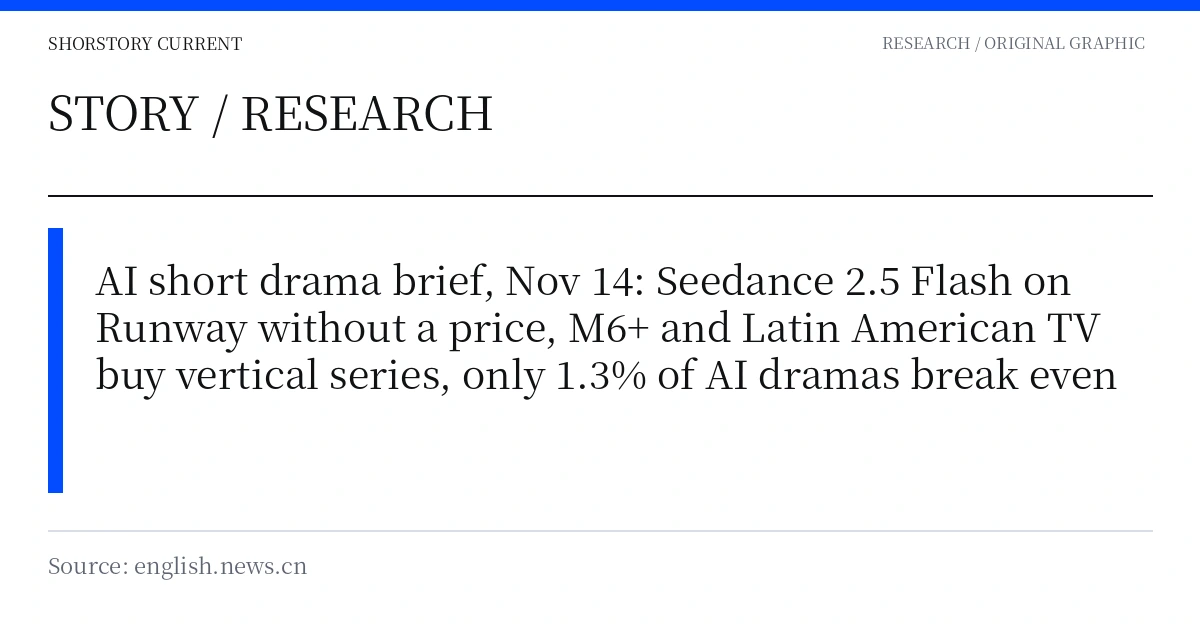
1. Models: Runway said on its official X account on November 13 that Seedance 2.5 Flash is live, promising faster and cheaper generation but no price or specs, and its developer price list did not show it yet. Volcano Engine's Ark API still opens on November 15 at 14:00 Beijing time.
2. Buyers: France's M6+ added a microdrama tab to its mobile app on November 12 with five international series, 350 episodes, free to watch, and Turkish distributor Inter Medya licensed its microdrama catalogue to ViX, El Salvador's Canal 2 and Colombia's Ditu. European and Latin American broadcasters are buying dubbed vertical series in batches.
3. The ledger: Xinhua, citing DataEye on November 13, says 50 million views is the accepted break-even line and only 1.3% of AI short dramas clear it; the same report's breakout hit, Armed into the Song Dynasty, comes from a six-person team that can turn out 100 episodes a week.
Models and pricing
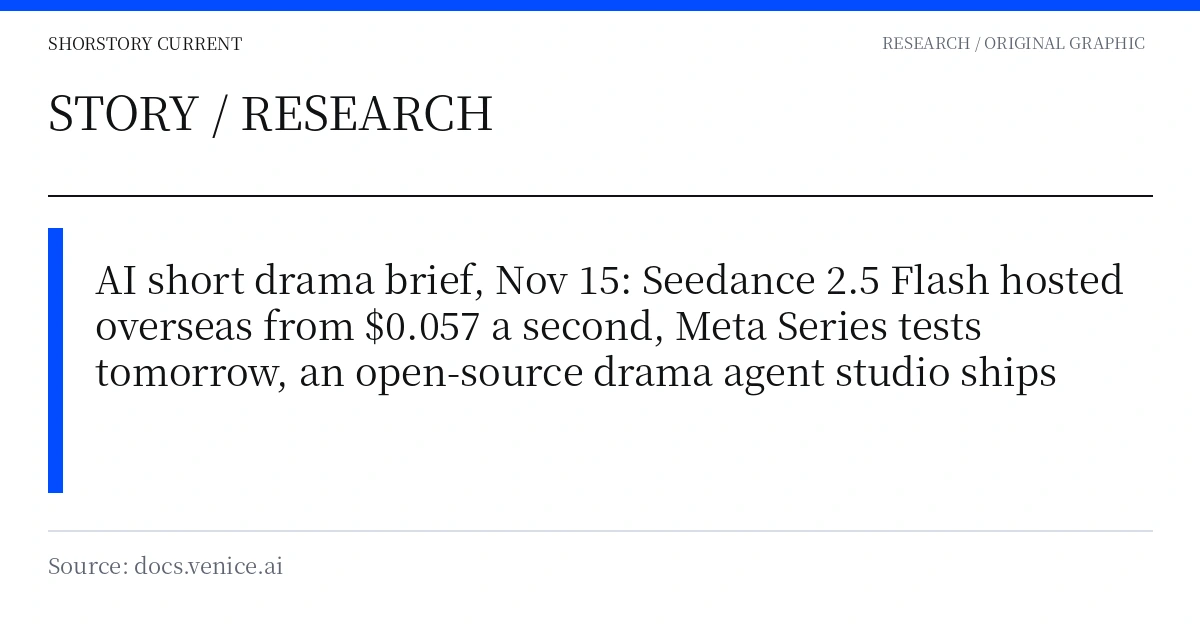
Seedance 2.5 Flash reaches Runway first. ORIENS reported on November 13 that Runway's official X post says Seedance 2.5 Flash is available on Runway and generates faster at lower cost, without stating price, resolution, clip length, eligible plans or API access. When we read Runway's developer price list on November 14 it still showed only flagship Seedance 2.5, at 30 credits (about $0.30) a second at 720p and 68 credits at 1080p, with no Flash row. Teams outside China can see the model but cannot budget it yet.
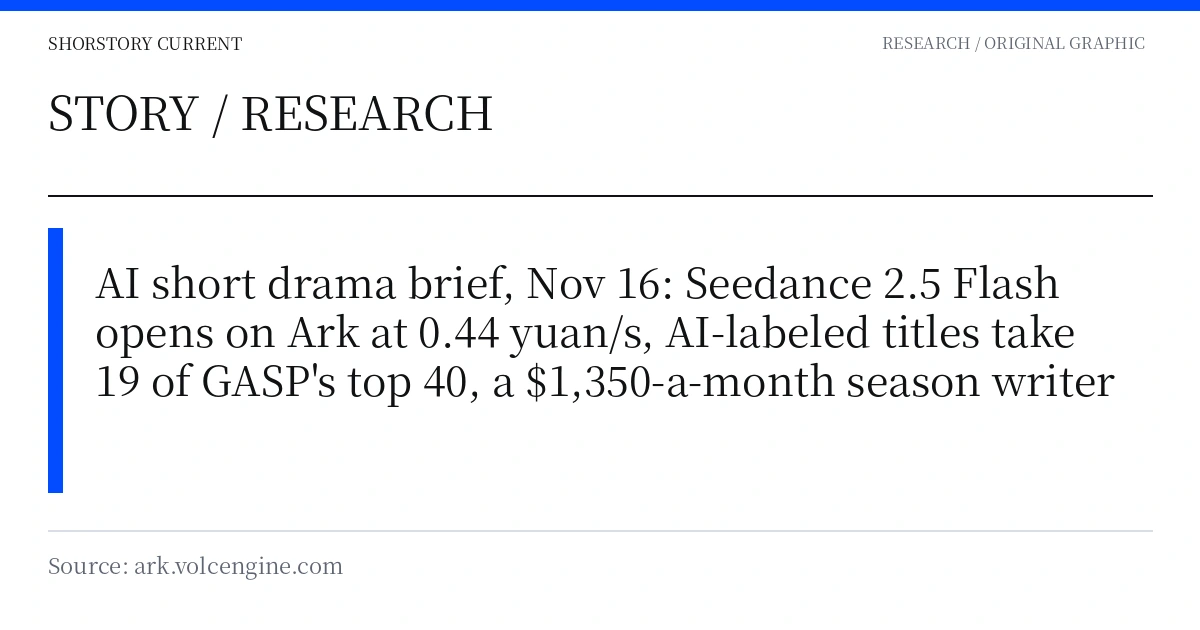
Volcano Engine's Ark documentation, read November 14, still says Seedance 2.5 flash opens for online use and API calls at 14:00 Beijing time on November 15, as we reported on November 13. Kling's API updates page still has the November 4 Kling 4.0 Flash entry (720p, 3 to 20 seconds) as its latest. No other official changes today.
Platforms and channels
M6+ puts microdramas inside its main app. VL Média reported on November 12 that M6 Group's streaming service M6+ has added a dedicated microdrama tab to its mobile app's navigation bar, with a portrait player built for back-to-back viewing. The launch slate is five international series totalling 350 episodes, free to watch, across romance, suspense and teen and young-adult stories and the section is available only on mobile. Suppliers and terms were not disclosed. With JLA Play adding vertical series a few weeks ago, French free-to-watch platforms are becoming a new outlet.
A Turkish distributor sells microdramas into Latin American TV. C21Media reports that Istanbul-based Inter Medya has licensed its Turkish microdrama catalogue to ViX, owned by TelevisaUnivision, El Salvador's Canal 2 and Ditu, the free streaming platform from Colombia's Caracol, covering streaming and linear television for US Hispanic and Latin American audiences. No dates or fees were given. Vertical series can be sold as a catalogue to traditional broadcasters, not only monetised in-app, if you hold licensable finished episodes and language versions.
Charts and hooks
No new weekly chart today; see our November 10 brief. Today's hook sample is Armed into the Song Dynasty: five modern soldiers land in the late Northern Song with rifles, a medical kit and dwindling ammunition and fuel. Xinhua's November 13 report says it premiered on August 22 and now runs 10 seasons and about 1,000 episodes of under two minutes each, with more than 4 billion views, made by a six-person team that can produce 100 episodes a week. Sixth Tone, citing local media the same day, puts views above 12 billion and episodes at about three minutes. The two figures differ threefold with no stated method, so treat them as an order of magnitude.
The same Xinhua report has colder numbers. DataEye treats 50 million views as the accepted break-even line, and only 1.3% of AI short dramas reach it, with 98.7% losing money. China's broadcast regulator says about 550,000 micro and short dramas were released in the first ten months of the year, more than 94% of them AI-made. Supply is up 17-fold and breaking even on any one title has become harder.
Adaptation and IP
AI vertical series as a test screening for live action. WIRED reported on November 13 that Mansa, founded by David Oyelowo and Nate Parker, has released They Left Us to Die, a fully AI-generated 30-episode zombie series, and says it uses AI shows to find which Black stories audiences will pay for before pitching live-action versions with the data. It has made nine live-action vertical series and two fully AI ones, and declined to share how the AI series perform. The show drew criticism online for having no human roles.
An actor-approved digital double. TheWrap reported the same day that Shortical's fully AI psychological thriller Inevitable premiered with 24 episodes on November 13, out of a planned 50 released weekly. Its lead is an AI double of Israeli actor Aki Avni, who took part in making it and approved the use of his likeness. That gives the industry a public example of how a real face can be licensed for an AI series.
Methods and workflow
Short-drama agents add approval gates. DomoAI launched InkoAI Agent on November 13. It starts from one sentence, can launch Short Drama, Anime Video and other Skills in one click, pauses for the user to approve the script, characters and shots before moving on, shows its plan before generating, and runs on 15 image and video models including Seedance 2.5 and MiniMax H3. This is a vendor release and we have not used it; the step-by-step approval structure is the part worth borrowing, not any claim about output quality.
Music licensing built for vertical series. Ecran Total reported on November 12 that Audio Network France has launched Cliffhanger, a licence for vertical series with episodes under three minutes, sold per series or per year, opening its whole catalogue (more than 300,000 tracks, it says), with each track available in cuts from three minutes down to about ten seconds. Prices were not published. For teams that use music to push viewers into the next episode, it is simpler than clearing tracks one by one.
What it means today
1. If you budget shots at Runway prices: keep Flash out of the budget until it appears on the developer price list or Ark opens on November 15, then compare unit cost and retakes on the same set of shots.
2. If your finished series only live inside an app: package them as a licensable catalogue (episode count, runtime, language versions, rights term); European free platforms and Latin American broadcasters are buying international vertical series in batches.
3. If you use AI series to test genres: working back from a 50-million-view break-even, the first episodes have to prove the hook. Treat AI episodes as data samples the way Mansa does, and put any real person's likeness rights in writing the way Shortical did.
What remains unclear
Seedance 2.5 Flash pricing and specs on Runway are not public; we rely on ORIENS's account of the official X post and on the missing row in Runway's price list. M6+ suppliers and terms are undisclosed; the Inter Medya deals have no dates or fees; Xinhua and Sixth Tone differ threefold on Armed into the Song Dynasty's views; the DataEye break-even line and 1.3% figure are cited by the press. InkoAI Agent and Cliffhanger are vendor claims; we did not use them, ask for prices or contact any party.
Method & limitations
On November 14, 2026 (Beijing time) we read ORIENS (November 13), Runway's developer price list, Volcano Engine's Ark documentation for Seedance 2.5, Kling's API updates page, VL Média on the M6+ microdrama offer, C21Media on Inter Medya, Xinhua's English report and Sixth Tone (November 13), WIRED and TheWrap (November 13), DomoAI's PR Newswire release and Ecran Total (November 12). The main window is November 12–13. Official information, vendor marketing, press accounts and editorial inference are labeled separately.
Seedance 2.5 Flash pricing and specs on Runway are not public; M6+ and Inter Medya deal terms are undisclosed; view counts are press figures and conflict; the break-even line and 1.3% figure are DataEye numbers cited by the press; the agent and music licence are vendor claims we did not try; we contacted no party; nothing here supports conclusions about any company's revenue or ranking.
Related research & methods
Sources & editorial note
These links identify the public sources. Third-party statistics remain attributed to their publisher; our studies state what was actually read or viewed. See the methodology for scope and limits.
Source published: Nov 13, 2026
Source published: Nov 13, 2026
Source published: Unknown; not confirmed by the source
Source published: Unknown; not confirmed by the source
Source published: Unknown; not confirmed by the source
Source published: Nov 12, 2026
Source published: Nov 12, 2026
Source published: Nov 13, 2026
Source published: Nov 13, 2026
Source published: Nov 13, 2026
Source published: Nov 13, 2026
Source published: Nov 12, 2026
- Published
- Nov 14, 2026
- Updated
- 14 Nov 2026, 08:03
- Verified
- 14 Nov 2026, 08:02