FICTION · DRAMA · CREATIVE INTELLIGENCE
In brief
Three lines for today
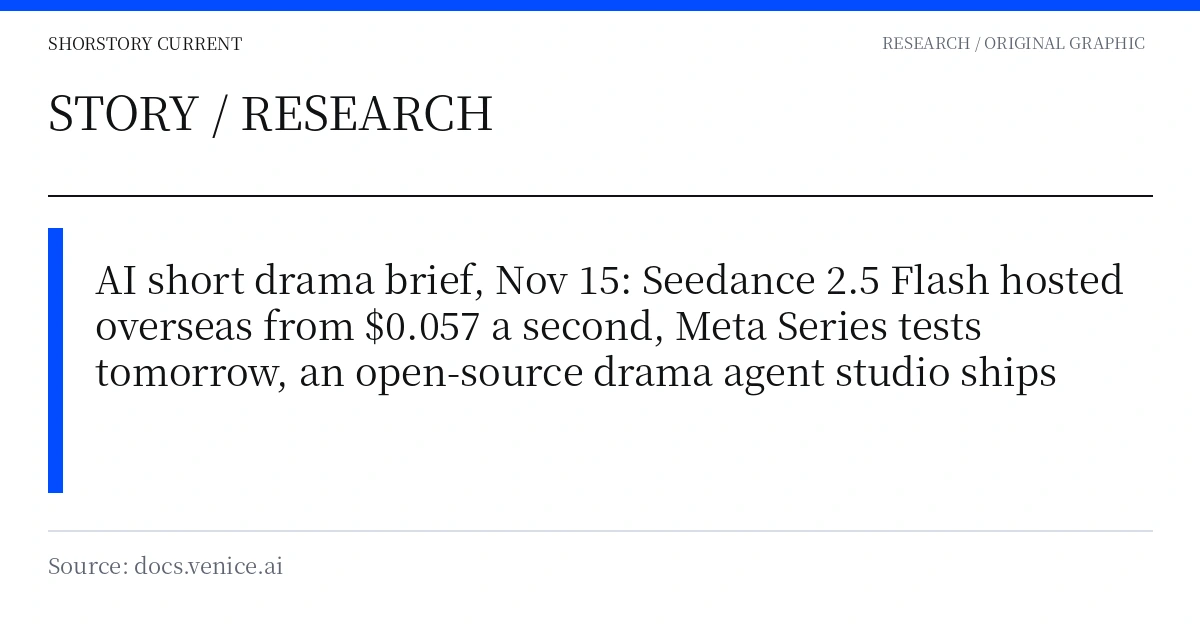
1. Models: Seedance 2.5 Flash now has public prices outside China. Venice's API docs list silent 480p at $0.0571 a second and 720p at $0.1235, with clips up to 30 seconds, while Runway's developer price list still had no Flash row on November 15. Volcano Engine's Ark API is due to open today at 14:00 Beijing time, as announced.
2. Channels: more free outlets opened this week. Deadline reports that Meta begins testing Series in some markets on November 16, with an early branded series already live on November 14; US Hispanic streamer Canela.TV announced a vertical slate that includes AI-assisted shows; and Google took a small stake in Rigi, India's free-to-watch microdrama app.
3. Workflow: Pine AI open-sourced Pine Drama Studio (Apache 2.0) on November 13. Agents take a screenplay through design, storyboards and the final cut, a person approves each step, and a change regenerates only the affected shots. Cloud generation is the paid part.
Models and pricing
Third-party prices for Seedance 2.5 Flash arrive first. Venice's model documentation, read November 15, lists text-to-video, image-to-video and reference-to-video variants at up to 720p and 4 to 30 seconds a clip. Silent output starts at $0.0571 a second at 480p and $0.1235 at 720p, about $0.57 for a 10-second 480p clip, and the same page lists Kling 4.0 Flash from $0.0822 a second. For comparison, Runway's developer price list still showed only flagship Seedance 2.5 that day (30 credits, about $0.30, a second at 720p) and no Flash. The Ark list price we read on November 13 was about 0.99 yuan a second at 720p, and Ark is due to open online use and the API at 14:00 today. Hosted prices include the platform's margin and can change, so check the order page.
Kling's API updates page added one entry on November 14: the text-to-video and omni-video endpoints for Kling 4.0 and Kling 4.0 Flash now accept 4:3 and 3:4. It does little for vertical drama, but it saves a crop for teams that also cut landscape trailers or square social posts. No other official changes today.
Platforms and channels
Meta Series starts testing tomorrow. Deadline reports that Meta will begin testing Series in some markets from November 16, letting selected creators bundle vertical Reels into episodes on Facebook and Instagram. Pixie USA's 20-episode Christmas romance Christmas at Maple Hollow Inn, made with food brand Bob Evans and running 38 minutes in total, launched on November 14 as one of the first titles and also plays on YouTube and TikTok. Meta has not said which markets, whether creators can earn from it, or how to apply.
Another free outlet for vertical series in the US Hispanic market. Vertical Observer, relaying C21Media on November 13, reports that Canela Media has announced a slate of vertical microseries for its free, ad-supported Canela.TV, mixing live-action and AI-assisted shows across fantasy, science fiction and supernatural romance, plus a vertical adaptation of the Turkish drama Kuma and three classic Mexican films restored and cut into short episodes. Supply terms were not disclosed.
Google buys a sliver of an Indian free microdrama app. Indian Television, citing regulatory filings seen by Entrackr, reported on November 14 that Google International bought 1,543 preference shares in Rigi at 61,796 rupees each, about 95 million rupees, for a 1.43% stake at a post-money valuation of about 6.7 billion rupees. Rigi TV is free to watch, earns from ads and in-app purchases, and shows more than 10 million downloads on Google Play. In China, Douyin's short-drama rights centre opened partnerships for interactive dramas on November 12, according to Guandian, offering up to 200,000 yuan in guaranteed payment per title plus a 30% to 50% revenue share, worth noting for teams that can write branching stories.
Charts and hooks
As of the morning of November 15, GASP's weekly chart still showed the November 1 to 8 edition (the page says it was last checked on November 14); we will update in Monday's brief once the new chart is out. In China, DataEye's November 14 daily chart, republished by duan.cn, shows 13 comic dramas above 100 million daily views, led by the cute-kid family-search title Xiao An Xun Qin at 340 million daily and 1.64 billion cumulative on Douyin. Child-searching-for-family premises, high on emotion and easy to follow, keep pulling volume in AI comic drama.
This week in review (November 9 to 15). On price, Seedance 2.5 Flash went from an Ark list price to a Runway launch with no price to third-party listings from $0.057 a second, so teams outside China can compare real shot costs next week. On buyers, Peacock, M6+, Inter Medya's Latin American broadcasters, Canela.TV and Meta Series all surfaced this week, widening the outlets for vertical series from paid apps to free TV and social platforms. On the ledger, Xinhua's DataEye figure of a 1.3% break-even rate is a reminder that cheaper production has not made breaking even easier.
Adaptation and IP
Naver Webtoon's parent becomes a DramaBox shareholder. Korea's Herald Business reported exclusively on November 11 that Webtoon Entertainment, which held about 5% of GoodShort's parent Tap Future, saw Tap Future absorbed on October 8 into Drama Times, the holding company above DramaBox. Webtoon swapped its shares for Series A1 preferred shares and then subscribed for more, joining Dianzhong Technology, Singtel Innov8 and Disney on the shareholder list; the stake size is undisclosed. The report adds that in August Webtoon released live-action vertical adaptations of six of its comics, each 40 to 50 episodes of one to two minutes, for North America and other markets. Comic IP owners and a top drama platform now share a capital link; neither side has confirmed joint production or distribution.
Methods and workflow
An open-source studio for short-drama agents. Pine AI released Pine Drama Studio on November 13. The GitHub repository is Apache 2.0, a desktop app built on Code-OSS (macOS, with a Windows installer built in CI). You give it a screenplay and one instruction; the agent designs characters, locations and props once for the whole series, then makes keyframes, storyboards, takes and the cut. Each paid step waits for the user to say go, a person approves designs, storyboards, takes and final cuts, and a script change regenerates only the affected shots. The workflow lives in plain-text skill files, so teams can swap models or add dubbing and localisation, and the project folder stays on the user's machine.
The release carries one number: an Australian AI short-drama company that moved over in October says each person went from 2 to 3 minutes of video a day to 30 to 50. That is Pine's claim, not independently checked, and we have not used the tool. Three ideas are worth borrowing: lock assets once and reuse them across the series, invalidate and regenerate at the shot level, and put a human gate before every paid step.
What it means today
1. If you budget AI drama shots: once Ark opens at 14:00 today, run the same 10 shots through Ark and one hosted Seedance 2.5 Flash provider, log unit price, failure rate and retakes, then choose 480p or 720p as your default.
2. If you hold licensable finished series: prepare separate packs for free TV, social platforms and paid apps (episode count, total runtime, language versions, openness to brand integration). Free outlets like Meta Series and Canela.TV want whole-series licences or sponsors, not coin revenue share.
3. If you build video agents or production tools: check your pipeline against Pine Drama Studio for a series-wide asset ledger, shot-level regeneration after script edits, and human sign-off before paid steps. Build the ledger first; the other two depend on it.
What remains unclear
Venice's Seedance 2.5 Flash price is a hosted third-party rate that includes the platform's margin and may change; the official Ark price after launch is what counts. Meta has not published Series test markets or monetisation rules; Canela.TV and Rigi supply terms and Webtoon's stake size are undisclosed; Douyin's interactive-drama incentives come from a press report, not the platform's own text; the DataEye daily chart is a third-party figure republished by duan.cn; Pine's output figures are vendor claims. We did not use any tool, contacted no party, and nothing here supports conclusions about any company's revenue or ranking.
Method & limitations
On November 15, 2026 (Beijing time) we read Venice's Seedance 2.5 Flash model documentation, Kling's API updates page, Runway's developer price list, Deadline on Christmas at Maple Hollow Inn and Meta Series, Vertical Observer on Canela.TV, Indian Television on Google's Rigi stake, Guandian on Douyin's interactive-drama partnerships, DataEye's November 14 daily chart as republished by duan.cn, Herald Business (November 11), and Pine AI's PR Newswire release and GitHub repository. The main window is November 12–15; the Sunday review covers November 9–15 and draws on our earlier issues. Official information, vendor marketing, press accounts and editorial inference are labeled separately.
Venice's Seedance 2.5 Flash price is a hosted third-party rate; Meta has not published Series test markets or monetisation rules; Canela.TV and Rigi terms and Webtoon's stake size are undisclosed; Douyin's interactive-drama incentives come from a press report; charts are third-party figures; Pine's output figures are vendor claims we did not test; we contacted no party; nothing here supports conclusions about any company's revenue or ranking.
Related research & methods
Sources & editorial note
These links identify the public sources. Third-party statistics remain attributed to their publisher; our studies state what was actually read or viewed. See the methodology for scope and limits.
Source published: Unknown; not confirmed by the source
Source published: Unknown; not confirmed by the source
Source published: Unknown; not confirmed by the source
Source published: Nov 6, 2026
Source published: Nov 14, 2026
Source published: Nov 14, 2026
Source published: Nov 12, 2026
Source published: Nov 14, 2026
Source published: Nov 11, 2026
Source published: Nov 13, 2026
Source published: Unknown; not confirmed by the source
- Published
- Nov 15, 2026
- Updated
- 15 Nov 2026, 07:55
- Verified
- 15 Nov 2026, 07:53