FICTION · DRAMA · CREATIVE INTELLIGENCE
In brief
Who this is for, and what it helps you decide
Short-drama writers, producers and production companies that supply Hongguo and similar platforms; teams that generate characters with AI for AI comic dramas or photoreal AI short dramas; and web-novel authors considering short-drama adaptations.
It helps you decide whether current projects need a similarity self-check before submission, whether a character library can be reused across titles, and which approval route to plan for when green-lighting a new project.
What Hongguo's notice says
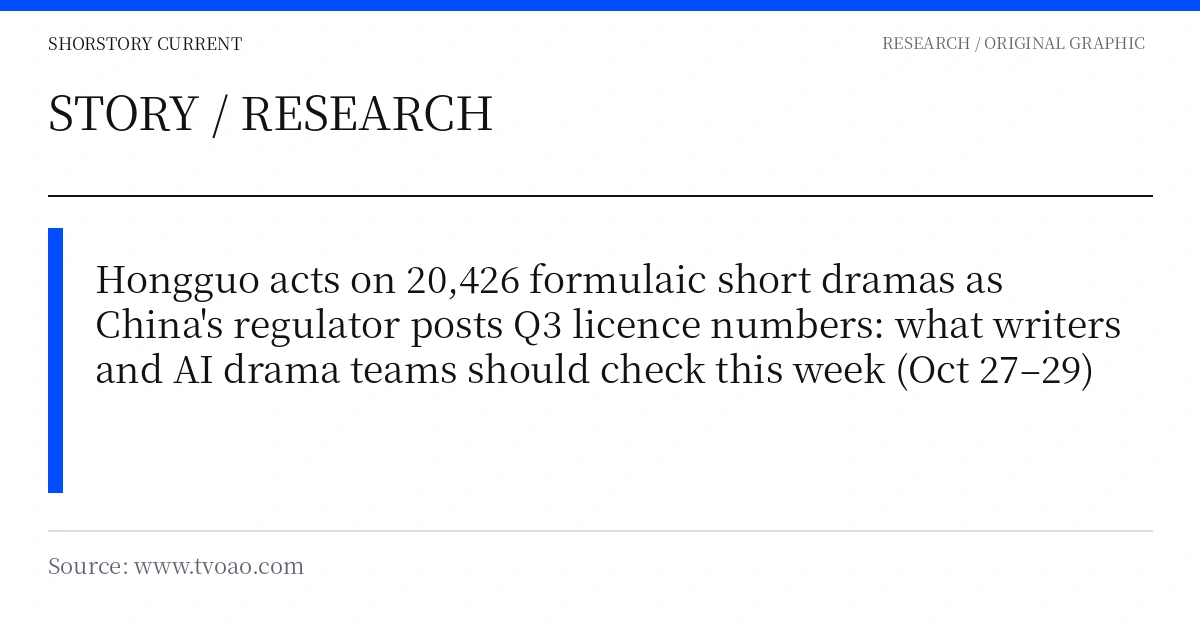
According to Yicai, Hongguo published a notice on stepping up its crackdown on low-quality and formulaic content on its official account on October 27. We read the full text as republished on October 28 by the trade site tvoao, which credits Hongguo as the source; we did not read the original post on Hongguo's account.
The notice says the platform will focus on "excessive emotional manipulation" and on formulaic reuse of plot structure, core premises, key set pieces, character relationships and audiovisual elements. It lists three patterns: deliberately inflating family, neighbour or workplace conflict for traffic, stacking twists and shouting matches without set-up or characterisation; plots whose premise, relationships, key beats and pacing are near-identical with only surface details changed, or mass "reskins" across series and accounts; and reusing the same face model or facial template across titles, so that different characters look alike.
Hongguo says that as of October 27, 2026 it had dealt with 20,426 such micro-dramas, citing six examples with titles partly masked, and urges creators to stay original and avoid template production.
The regulator's Q3 licence figures
NRTA general office notice No. 8 of 2026 (signed October 23, posted on the NRTA site on October 29) says regulators licensed 338 domestic micro-dramas and online animated series totalling 7,100 episodes in July–September: 158 micro-dramas with 5,369 episodes and 180 animated series with 1,731 episodes. That works out to about 34 episodes per micro-drama.
Urban stories were the largest micro-drama category (38 titles), followed by legend and "other" (24 each), revolutionary history (20) and police (18). Animated series were mostly legend (76) and youth (54).
In the attached list, micro-drama licence numbers appear in two formats: the older "网微剧审字" and a newer "微短剧审字". By our rough line-by-line count, slightly more than half use the older format and just over 40 percent the newer one; the notice does not explain which approval each format corresponds to.
Under the Micro-Drama Development Measures in force since September 1, tier-one micro-dramas receive a licence, tier-two titles receive an approval document from provincial regulators, and tier-three titles (low-budget, general subject matter) are reviewed and numbered by the streaming platform itself. These figures therefore exclude the large volume of tier-three titles cleared by platforms.
What remains unclear
Hongguo does not say whether "dealt with" means removal, reduced distribution or something else, and it has not published its similarity criteria, the time period covered, whether AI-generated titles are included, or how creators can appeal. The 20,426 figure is self-reported and not independently verified.
The NRTA notice counts licensed titles, while Hongguo's figure covers its whole catalogue, so no ratio of approvals to removals can be drawn. Our count of licence-number formats combines automated extraction with spot checks and may be off by a few rows.
What it may mean for creators (editorial inference, untested)
Because the notice lists plot structure, core premises, key beats and character relationships as possible grounds for a similarity finding, swapping names and settings on a proven template now looks much riskier. Writers could check the past year's projects against the three patterns before submission and keep outlines, episode synopses and revision history to show original work if a title is flagged.
For AI drama and AI comic teams, reusing one face model is named explicitly. When building a character library, give each series its own lead designs rather than letting the same face recur across titles and accounts, and add the per-episode AI-generated label the Measures require.
For scheduling, tier-one and tier-two titles go through regulators, while tier-three titles rely on platform review; budget and subject matter decide the route. All of this is editorial inference that the platform has not confirmed.
Method & limitations
On October 30, 2026 (Beijing time) we read NRTA notice No. 8 of 2026 and its PDF list on the NRTA website, the full text of the Micro-Drama Development Measures, Yicai's October 27 report on Hongguo's notice and tvoao's October 28 republication of the full notice. Hongguo's wording comes from the republished text and its date from Yicai's report; the split between licence-number formats is our own line-by-line count of the attachment. Creator implications are editorial inference and labelled as such.
We did not read the original post on Hongguo's official account, only media republications. Hongguo has not published the affected titles or its criteria, so the 20,426 figure cannot be verified independently. The licence-number count may contain small extraction errors. We did not contact Hongguo or NRTA or check any individual title.
Related research & methods
Fanqie's second-version posting rules: daily caps on new books, updates and words, by author level
Sources & editorial note
These links identify the public sources. Third-party statistics remain attributed to their publisher; our studies state what was actually read or viewed. See the methodology for scope and limits.
Source published: Oct 28, 2026
Source published: Oct 27, 2026
Source published: Oct 29, 2026
Source published: Oct 29, 2026
Source published: Jul 31, 2026
- Published
- Oct 30, 2026
- Updated
- 30 Oct 2026, 07:56
- Verified
- 30 Oct 2026, 07:55